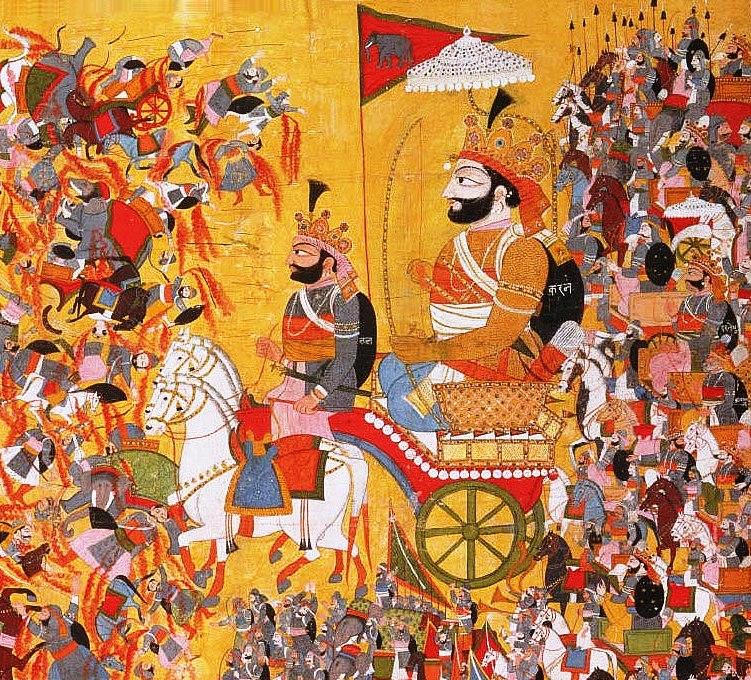

Karna is one of the most compelling figures in the Mahabharata because his life refuses to fit neatly into the categories of hero or villain.
He is remembered as a formidable warrior, a generous giver, a loyal friend, and a man whose choices ultimately tied him to a losing side.
His story is not simply about how a warrior fights;
it is about what happens when talent, identity, gratitude, pride, loyalty, and moral responsibility pull a person in different directions.
Quick Summary
- Karna is presented in the Mahabharata tradition as the firstborn son of Kunti, born through her invocation of Surya before her marriage.
- He is raised by Adhiratha and Radha after being abandoned as an infant, giving his identity a complicated foundation.
- His rivalry with Arjuna becomes one of the epic’s defining conflicts.
- Duryodhana gives him status by making him king of Anga, and he remains deeply loyal to him.
- His generosity is legendary, including his decision to give away his natural armour and earrings.
- Near the end of his life, he learns the truth about his birth but chooses not to abandon Duryodhana.
- His life is ultimately a study in the difference between personal loyalty and moral judgment.
What You’ll Learn
This article looks at Karna as a complete character rather than reducing him to a tragic hero, misunderstood villain, or perfect warrior.
We will examine his birth, upbringing, rivalry with Arjuna, loyalty to Duryodhana, generosity, moral failures, and the lessons his story can offer a modern reader.
For a wider look at the warrior tradition behind this article, see
Who Are The Greatest Warriors Of The Indian Mythos? and Who is the better warrior?
These broader Better Warrior articles provide useful context for how warrior stories connect with character, courage, and personal growth.

Who Was Karna?
Karna is one of the major warriors of the Mahabharata.
In the traditional account, he is the firstborn child of Kunti, conceived through the power of a divine invocation to Surya, the sun deity.
He is born with divine armour and earrings, often described as kavacha and kundala.
Kunti, still unmarried and fearful of the consequences of having a child, places the infant in a basket and sets him afloat.
He is found and raised by Adhiratha, a charioteer, and his wife Radha.
This upbringing becomes central to his identity.
The tragedy begins here.
Karna possesses exceptional ability, but the world around him does not initially recognise him for who he believes himself to be.
He wants the status of a warrior and the respect that comes with it. Yet his social position repeatedly becomes an obstacle.
This tension between ability and recognition follows him for much of the epic.
Karna and the Search for Recognition
One of the most important ways to understand Karna is through his need to be recognised.
His rivalry with Arjuna is not only a contest between two archers.
It becomes a contest over legitimacy.
Arjuna already has what Karna wants: respected lineage, royal protection, training, recognition, and a place among the Pandavas.
He has extraordinary ambition and ability, but his upbringing makes others question whether he belongs among the elite warriors.
The epic repeatedly places him in situations where his competence is measured against his perceived birth.
That creates a dangerous psychological pressure.
When someone spends years being told that they do not belong, recognition can become more valuable than judgment.
The person who finally says, “I see your worth,” can become extremely important.
For Karna, that person is Duryodhana.
Why Duryodhana Mattered to Karna
Duryodhana does something that changes his life: he gives him status.
When Karna is challenged over his right to participate as a warrior, Duryodhana elevates him by making him king of Anga.
That act gives him the public recognition he has been seeking.
From that point, their relationship becomes one of the central bonds in the story.
He does not forget who stood beside him when others questioned his worth.
This loyalty is one of his greatest strengths, but it is also where his tragedy deepens.
Gratitude can be a virtue.
But gratitude becomes dangerous when it removes our ability to question the person to whom we feel indebted.
He remains committed to Duryodhana even as Duryodhana’s actions become increasingly difficult to defend.
His loyalty is powerful precisely because it is not convenient.
He does not abandon his friend when doing so would be easier.
But the Mahabharata also forces us to ask an uncomfortable question:
Is loyalty still a virtue when the person we are loyal to is doing something wrong?

Karna and Arjuna: More Than a Rivalry
The rivalry between Karna and Arjuna is one of the most memorable conflicts in the Mahabharata.
Both are exceptional archers, driven by ambition and determined to prove themselves.
Each receives powerful training and weapons, giving their rivalry an even deeper edge.
But their stories develop in very different environments.
Arjuna’s journey is strongly connected to discipline, mentorship, duty, and his relationship with Krishna.
Karna’s journey is shaped more heavily by rejection, recognition, gratitude, and the need to prove himself.
That difference matters.
He often appears to fight not only against an opponent but against the judgment of the world around him.
Arjuna is trying to fulfil a role.
Karna is also trying to prove that he deserves one.
That makes their rivalry emotionally larger than a simple question of who is the better archer.
The Generosity of Karna
Karna is famous for generosity.
His willingness to give is one of the qualities most consistently associated with his character. The traditional narrative describes him as someone who did not easily refuse a genuine request for charity.
One of the most famous episodes involves Indra, Arjuna’s divine father, who approaches Karna in disguise and asks for his natural armour and earrings.
He understands what giving them away means, yet he gives them up.
The story is often remembered as proof of his extraordinary generosity.
But there is a deeper lesson here.

Generosity is admirable because it requires us to let go of something we value.
Yet generosity without judgment can also become self-destructive.
His willingness to give is one of the qualities that makes him admirable.
It also reminds us that a virtue becomes healthier when it is guided by wisdom.
Strength is not merely the ability to give everything away.
Sometimes strength is knowing what must be protected.
Karna’s Greatest Strength Was Also His Weakness
Karna’s loyalty gives his character emotional power, but it also becomes his trap.
He is grateful to Duryodhana for giving him dignity when others withheld it.
That gratitude becomes a bond stronger than self-interest.
Even when Krishna reveals the truth about his birth and offers him the possibility of joining the Pandavas, he refuses to simply walk away from Duryodhana.
The Mahabharata tradition presents this encounter as one of the central moral choices surrounding his character.
This is one of the most revealing moments in his story.
He knows that his identity is more complicated than he believed.
He learns that Kunti is his biological mother and that the Pandavas are his younger brothers.
Yet he does not treat this discovery as a reason to erase his past.
He remembers the people who raised him.
He remembers the friend who gave him a kingdom.
Moreover, he remembers the person who stood beside him when society did not.
That decision makes Karna tragic, but it does not make every decision he made morally correct.
Karna Was Not a Perfect Hero
It is tempting to turn Karna into a symbol of pure goodness because his life contains so much suffering.
That would miss the point.
He participates in the Kaurava cause and is associated with actions that cause serious harm. His role in the humiliation of Draupadi is one of the clearest examples of why his character cannot be reduced to a “misunderstood hero.”
The Mahabharata’s treatment of the character leaves room for admiration and moral criticism at the same time.
The Mahabharata gives us a much more uncomfortable figure.
Karna can be generous and still be wrong.
He can be courageous yet still make harmful choices.
He can remain loyal while standing behind someone whose actions deserve opposition.
And he can suffer rejection without being free from responsibility for what he does afterwards.
That complexity is precisely why his story survives.

What Karna Teaches Us About Talent
His life also raises a question that matters far beyond mythology:
What happens when talent grows in an environment that does not recognise it?
His answer is relentless self-development.
He seeks out teachers, pursues advanced weapons training, and challenges established warriors.
Despite repeated setbacks, he continues to push himself, determined to prove his worth.
That determination is worth respecting.
But there is a second lesson.
Talent does not automatically produce wisdom.
A person can become extremely capable while still carrying unresolved insecurity, resentment, or the need for external validation.
His abilities grow enormously. His emotional conflicts do not disappear simply because he becomes stronger.
That distinction matters in modern life.
You can become fitter, richer, more skilled, more successful, or more respected and still remain controlled by the same insecurity that existed before you achieved those things.
Improvement is not only about becoming more capable.
It is also about becoming more aware of what drives your choices.
The Warrior Lens™
The warrior lesson in Karna’s story is not “always stay loyal.”
It is more demanding than that.
A Better Warrior learns to separate gratitude from obedience.
You can appreciate the person who helped you without surrendering your moral judgment to them.
You can honour where you came from without letting your past determine every choice you make.
Most importantly, you can acknowledge rejection without making the need to prove yourself the foundation of your identity.
And you can be extraordinarily talented while still accepting that talent does not make every decision righteous.
Karna’s story therefore challenges a common idea of strength.
Strength is not only enduring hardship.
Strength is also having enough clarity to examine the loyalties, wounds, and ambitions that hardship created inside you.
A Moment of Reflection
There is something deeply human about his need to be recognised.
Most people will never stand on a battlefield like Kurukshetra.
But many people know what it feels like to be underestimated, excluded, compared with someone else, or valued only after they prove themselves.
That experience can become fuel.
It can push you to work harder, develop greater discipline, and build the determination to become someone who cannot be easily overlooked.
But there is a danger in building your entire identity around proving your worth.
Eventually, you may stop asking, “What is right for me?” and start asking only, “What will finally make them respect me?”
Those are not the same question.
His story invites us to notice the difference.

The Warrior Question
If you removed the need to prove yourself to the people who once underestimated you, what would you choose to become?
What Happened to Karna?
He ultimately fights on the Kaurava side during the Kurukshetra War and faces Arjuna in the climactic conflict between the two warriors.
Arjuna ultimately kills him at Kurukshetra.
His death is surrounded by the same moral complexity that defines the rest of his life.
Before his final battle with Arjuna, Karna faced another formidable opponent: Ghatotkacha, Bhima’s son.
Ghatotkacha’s powerful attacks and illusions pushed Karna to use the divine Śakti weapon he had been saving for Arjuna.
Karna killed Ghatotkacha with the weapon, but by using it then, he lost the weapon he had intended to use against Arjuna.
His chariot wheel becomes stuck, and the circumstances of the final encounter are deeply connected to the wider pattern of actions and consequences in the war.
The end of his life does not provide a simple verdict on his character.
Instead, it leaves us with a harder conclusion: a person can possess extraordinary qualities and still make choices that lead to tragedy.
Frequently Asked Questions
Who was Karna in the Mahabharata?
Karna is one of the Mahabharata’s major warriors.
He is traditionally presented as Kunti’s firstborn son, raised by Adhiratha and Radha, and later becoming a close ally of Duryodhana.
Was Karna a Pandava?
Yes. In the traditional Mahabharata account, Karna is Kunti’s firstborn son and therefore the elder half-brother of the Pandavas.
His true parentage is revealed to him later in the epic.
Why was Karna loyal to Duryodhana?
Duryodhana gave Karna public status and made him king of Anga at a crucial point in his life.
Karna’s gratitude and friendship became one of the strongest forces shaping his later decisions.
Was Karna a good or bad person?
The Mahabharata does not require a simple answer. Karna possesses admirable qualities such as courage, generosity, and loyalty, yet also engages in morally harmful actions.
His complexity is a major reason his character remains debated.
Who killed Karna?
Arjuna ultimately killed Karna during the Kurukshetra War.
Why Karna Still Matters
Karna remains memorable because his story is not really about being unlucky.
It is about the choices we make as we carry the weight of our circumstances.
- He was born into a hidden identity.
- He was raised away from his biological family.
- He faced questions about his status.
- He found recognition through Duryodhana.
- He developed exceptional abilities.
- He became fiercely loyal.
- He made morally troubling choices.
And when the truth about his birth finally arrived,
he chose the life and relationships he had built rather than simply accepting the identity that had been hidden from him.
That is why Karna remains such a powerful character.
He reminds us that adversity can shape us, but it does not excuse every decision we make because of it.
The better path is not to become someone who never struggles with rejection, pride, loyalty, or insecurity.
The better path is to become someone who can recognise those forces before they start making decisions on his behalf.
Karna’s life is tragic, but the lesson does not have to be.
Be a little better than yesterday.