
Estimated Reading Time: 10–12 minutes
Arjuna is one of the most compelling warriors in the Mahabharata because his greatest challenge was not becoming powerful.
It was learning what to do with that power.
He is remembered as an extraordinary archer, a disciplined student, a master of weapons, and the warrior at the centre of the Bhagavad Gita.
Yet when the armies gathered at Kurukshetra, Arjuna saw his relatives, teachers, friends, and elders standing on the opposing side.
Despite all his training, he did not want to fight them.
His problem was not that he had forgotten how to fight. He no longer knew whether he should.
His story is therefore about more than archery.
It is about discipline, mastery, doubt, guidance, responsibility, and the difference between being able to do something and understanding why you should do it.
Quick Summary
- Arjuna was one of the five Pandava brothers and is traditionally described as the son of Kunti and Shree Indra.
- He trained under Drona and became one of the most accomplished archers and warriors of his generation.
- His reputation came from a combination of talent, concentration, discipline, and extensive training.
- His rivalry with Karna became one of the defining conflicts of the Mahabharata.
- Shree Krishna became his charioteer and guide during the Kurukshetra War.
- Before the battle, Arjuna became unwilling to fight after seeing his relatives, teachers, friends, and elders among the opposing army.
- Shree Krishna’s teachings led Arjuna to reconsider his understanding of duty, action, attachment, and responsibility.
- His story suggests that mastery is incomplete until a person understands what that mastery is meant to serve.
What You’ll Learn
Arjuna’s story is often reduced to his ability with a bow.
That misses what makes him interesting.
His life gives us a chance to look at how exceptional ability is developed, how rivalry can shape ambition, and what happens when years of preparation meet a decision that cannot be solved through skill alone.
We will follow Arjuna from his training under Drona to his rivalry with Karna, then to the moment at Kurukshetra when he no longer wants to fight.
From there, the story turns toward Shree Krishna and the questions of duty and responsibility that make the Bhagavad Gita central to Arjuna’s journey.
For a wider look at the warrior tradition within Indian mythology, see Who Are The Greatest Warriors Of The Indian Mythos?
The broader Better Warrior perspective helps place Arjuna alongside other figures rather than treating his story as an isolated legend.

Who Was Arjuna?
Arjuna was the third of the five Pandava brothers and one of the central warriors of the Mahabharata.
In the traditional account, he was born to Kunti through her invocation of Shree Indra.
He grew up as a prince whose education placed considerable emphasis on warfare and martial discipline.
His most important early teacher was Drona. Under Drona’s instruction, Arjuna developed a reputation for exceptional skill, particularly with the bow.
The Mahabharata tradition repeatedly presents him as deeply committed to learning the science of weapons, and his ability is associated not just with talent but with persistence and concentration.
That distinction is worth noticing because Arjuna was not simply handed the reputation of being the greatest archer. He spent years building it.
The same principle appears in almost every serious pursuit.
Natural ability can give someone an initial advantage, but sustained practice turns that advantage into dependable competence. Arjuna’s story makes that process central to his identity.
How Arjuna Became a Master Archer
One of the traditional stories about Arjuna’s training begins with something surprisingly ordinary: eating in the dark.
When a lamp went out while he was eating, Arjuna noticed that his hand could still find his mouth even though he could no longer see clearly.
He realised that repeated practice had made the movement almost automatic.
From that observation, he began to think about whether the same principle could be applied to archery, including practice in darkness.
The episode is revealing because Arjuna does not merely receive instruction and repeat it. He notices something about his own behaviour and finds a way to apply it to his training.
That kind of curiosity is easy to overlook when the story is remembered mainly for his spectacular feats.
Another famous episode involves Drona testing his students by asking them to aim at an artificial bird.
While the other students describe the bird, the tree, or their surroundings, Arjuna focuses on the target itself.
When Drona tells him to shoot, he strikes it.
The point of the story is not simply that Arjuna has better eyesight than everyone else. His advantage is concentration.
He can narrow his attention when the situation demands it, which becomes one of the defining characteristics of his skill.
That is a useful lesson even outside combat. In a world filled with competing demands, the ability to decide what deserves your full attention is itself a form of strength.
The Discipline Behind Arjuna’s Skill
Arjuna’s training also demonstrates the difference between being good at something and continuing to become better at it.
He does not limit himself to one weapon or one type of combat.
His education encompasses different forms of warfare, and his later adventures expose him to increasingly difficult opponents and powerful celestial weapons.
His reputation grows because his competence keeps expanding.
This matters because success can create its own trap.
Once people begin identifying you as the person who is good at something, protecting that reputation can become more important than improving the underlying skill.
You start defending what you have already achieved instead of asking what you still need to learn.
Arjuna’s story offers a different model. His reputation is built through continued development, not through a single achievement.
The lesson is not that everyone needs to become extraordinary.
It is that if something matters to you, competence is rarely created by occasional effort.
It comes from the less glamorous process of returning to the same craft repeatedly, correcting weaknesses, and remaining willing to learn after you have already become good.
Gandiva and the Meaning of Capability
Arjuna’s bow, Gandiva, becomes closely associated with his identity as a warrior.
In the traditional narrative, it is a remarkable divine weapon, and Arjuna carries it through the great battles of his life.
But Gandiva is more interesting as a symbol than as an object.
It represents capability. Arjuna has the weapon, the training, the experience, and the confidence to use them.
He has spent years becoming someone capable of doing what other people cannot.
Yet capability creates a question that skill itself cannot answer: What should you do with what you can do?
That question is easy to avoid when life is going well.
If your abilities are producing recognition, money, status, or progress, there may be little incentive to stop and examine the purpose behind them.
The harder moment comes when using your abilities carries a cost you did not expect.
That is exactly what happens to Arjuna at Kurukshetra.

Arjuna and Karna: Two Extraordinary Warriors
Arjuna’s rivalry with Karna is one of the most memorable conflicts in the Mahabharata because the two warriors have so much in common while travelling through very different lives.
Arjuna and Karna are both exceptional archers, driven by ambition and a determination to establish themselves.
Each receives powerful training and weapons, while both aspire to be recognised among the greatest warriors of their generation.
Their motivations, however, are not identical.
Arjuna grows within the Pandava family and receives the protection, training, and recognition associated with his position.
Karna spends much of his life confronting questions about his identity and social status, and his relationship with Duryodhana becomes deeply connected to the recognition he receives from him.
That difference gives their rivalry an emotional dimension beyond skill.
Arjuna is trying to live up to the demands of the role he has been given.
Karna is also trying to prove that he deserves a role he believes the world has denied him.
Both forms of pressure can produce extraordinary effort. They can also create vulnerabilities.
A person who is afraid of losing their position may become attached to proving themselves, while a person who has spent years trying to earn recognition may find it difficult to question the people who finally gave it to them.
Their rivalry therefore becomes about more than who is the better archer.
It becomes a clash between two identities shaped by very different circumstances.
Why Shree Krishna Mattered to Arjuna
Arjuna’s most important guide eventually becomes someone who does not teach him another technique.
It is Shree Krishna.

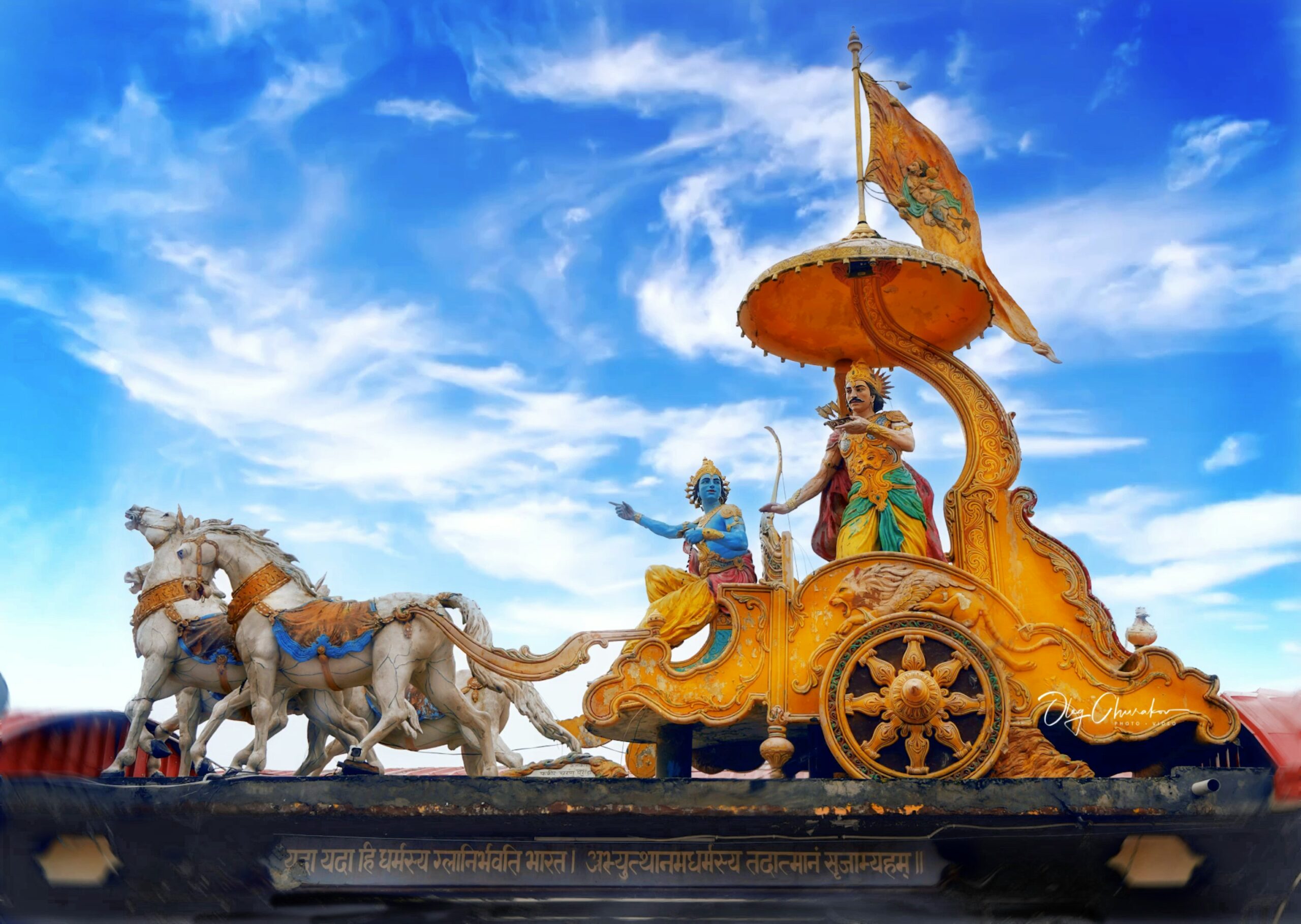
Before the Kurukshetra War begins, Shree Krishna agrees to serve as Arjuna’s charioteer. When the armies are assembled, Arjuna asks Him to place the chariot between the two forces so that he can see those gathered for battle.
What Arjuna sees changes his state of mind.
The people opposite him are not strangers.
They include relatives, teachers, friends, and elders.
The battlefield suddenly becomes personal in a way that all his previous training could not prepare him for.
The Bhagavad Gita records Arjuna questioning the value of victory, kingdom, and pleasure when achieving them would require the deaths of people he loves.
He tells Shree Krishna that he does not want to fight the people standing before him and becomes overwhelmed by the consequences he believes the battle will bring.
This is the moment behind our headline.
Arjuna does not suddenly lose his ability.
He remains fully capable of fighting.
His years of training have not disappeared.
What changes is his willingness to fight the people standing before him.
That distinction matters. His hesitation is not a general rejection of warfare; it is a moral and emotional crisis caused by the people he sees on the opposing side.
The Moment Arjuna Lost His Certainty
There is something unusually human about this part of the story.
Arjuna has spent years preparing for difficult situations.
He has trained with one of the greatest teachers of his generation, developed extraordinary concentration, learned to use powerful weapons, and established himself as a warrior capable of facing formidable opponents.

Then he encounters a situation in which none of those accomplishments gives him an answer.
His problem is not “Can I do this?”
It is “Should I do this?”
Those questions sound similar, but they are fundamentally different.
The first is a question of competence.
The second is a question of judgment.
That distinction appears in modern life more often than we might admit.
You may be capable of taking a promotion without wanting the life that comes with it.
You might remain in a difficult situation simply because you can endure it, even while questioning whether staying is the right decision.
A person can also become highly successful at pursuing a particular goal, only to realise later that the success itself no longer feels meaningful.
Arjuna’s crisis begins when his ability and his understanding stop moving in the same direction.
He has spent his life learning how to act.
Now he has to learn how to decide.
What Shree Krishna Taught Arjuna
Shree Krishna’s response to Arjuna is not simply an instruction to stop feeling and start fighting. Their conversation develops into a much deeper examination of duty, action, attachment, knowledge, and responsibility.
Arjuna is focused on the consequences that he can see.
He sees people he loves, the destruction that war may cause, and a victory that suddenly appears empty if it comes at that price.
Shree Krishna challenges him to consider responsibility from another perspective.
The conversation therefore moves beyond the immediate question of whether Arjuna feels like fighting.
It asks what it means to act according to one’s duty when emotion, attachment, fear, and consequence all make the decision difficult.
That does not make the decision emotionally easy.
It gives Arjuna a framework through which to understand it.
This is an important difference.
Good guidance does not always remove uncertainty by handing us a comfortable answer. Sometimes it gives us a better way to examine the uncertainty ourselves.
By the end of the Bhagavad Gita, Arjuna’s position has changed.
He tells Shree Krishna that his confusion has been dispelled and that he is prepared to act according to His instruction.
The warrior has not acquired a new weapon.
He has gained clarity about how he understands his responsibility.

Why Skill Alone Wasn’t Enough
Arjuna’s story becomes powerful precisely because his greatest crisis happens after he has already achieved so much.
If the problem had been lack of skill, another archery lesson could have solved it.
If the problem had been lack of courage, another demonstration of bravery might have been enough.
But neither was the real issue.
Arjuna had the ability.
What he lacked was certainty about how that ability should be used.
That is a problem that technical excellence cannot solve on its own.
The more capable you become, the more important your judgment becomes because your decisions can have greater consequences.
A talented person can still make a poor decision. A disciplined person can remain committed to the wrong objective.
Someone who is highly successful can discover that they have spent years becoming excellent at a life they do not actually want.
Arjuna’s crisis reminds us that capability and wisdom are different achievements.
One tells you what you can do.
The other helps you decide what deserves to be done.
The Warrior Lens™
A Better Warrior should take Arjuna’s discipline seriously, but should not stop at admiration for his skill.
The deeper lesson is that mastery should increase your responsibility, not reduce your need for judgment.
When you become good at something, it becomes tempting to let that ability define you.
You become the successful person, the expert, the high performer, the reliable one.
Eventually, saying no to an opportunity can feel like admitting that you are not as capable as people believe.
Arjuna’s crisis offers another way of looking at capability.
Sometimes the most important question is not whether you can carry a greater burden, but whether the burden is worth carrying.
That does not mean avoiding difficult things whenever they become uncomfortable.
It means learning to distinguish discomfort from genuine misalignment.
A Better Warrior should be willing to work hard without becoming blindly attached to the goal, develop strength without needing to display it constantly, and build competence without assuming that competence makes every decision correct.
The point of mastery is not simply to become powerful.
It is to become trustworthy with power.
A Moment of Reflection
Most people will never face anything remotely comparable to Arjuna’s situation at Kurukshetra. Yet many people eventually reach a quieter version of the same crossroads.
Perhaps you have spent years building a career because you were good at it.
You may have pursued a goal largely because the people around you expected it of you.
Over time, you can even become successful at something that once mattered deeply, only to realise that the person who wanted it is no longer quite the same person you are today.
Those moments can be uncomfortable because changing direction can feel like wasting everything you have already invested.
But experience is not wasted simply because it changes what you choose next.
The discipline you developed, the mistakes you made, and the things you learned remain part of you even when the original goal no longer deserves the same place in your life.
Arjuna’s story is therefore not an argument against ambition.
It is a reminder to examine ambition before allowing it to make every important decision for you.
The Warrior Question
If you knew you could succeed at something, but were no longer certain you wanted what came with that success, would you still pursue it?
What Happened to Arjuna?
Arjuna eventually fights in the Kurukshetra War and becomes one of the most important warriors on the Pandava side.
His battles with the great warriors of the opposing army include the climactic confrontation with Karna.
The significance of Arjuna’s eventual return to battle is not simply that he wins fights.
The warrior who once lowered his weapon has reached a different understanding of his role and responsibility.
His story continues beyond the battlefield, however, and the later stages of the Mahabharata place his martial achievements in a broader perspective.
Arjuna’s strength is not permanent, nor is his position as a celebrated warrior the final measure of his life.
That is an important ending for someone whose identity was so closely connected with skill.
No matter how exceptional your ability becomes, there will eventually be things you cannot control, abilities that change with time, and achievements that no longer define what matters most.
The question then becomes what remains when the thing you were best at is no longer enough to define you.

Frequently Asked Questions
Who was Arjuna in the Mahabharata?
Arjuna was one of the five Pandava brothers and one of the central warriors of the Mahabharata.
He was renowned for his archery, trained under Drona, and became the warrior to whom Shree Krishna delivered the teachings of the Bhagavad Gita.
Why was Arjuna considered such a great warrior?
Arjuna’s reputation came from a combination of disciplined training, concentration, technical ability, battlefield experience, and mastery of powerful weapons.
His skill was developed over many years rather than being based solely on natural talent.
Why did Arjuna not want to fight?
Arjuna became unwilling to fight after seeing relatives, teachers, friends, and elders among the opposing army at Kurukshetra.
He questioned the value of victory when achieving it would require killing people to whom he was deeply attached.
What was Arjuna’s relationship with Shree Krishna?
Shree Krishna was Arjuna’s close companion and became his charioteer during the Kurukshetra War.
When Arjuna experienced his crisis before battle, Shree Krishna guided him through the dialogue that became the Bhagavad Gita.
Did Arjuna eventually fight?
Yes. After his conversation with Shree Krishna, Arjuna accepted his understanding of duty and returned to battle.
He subsequently played a major role in the Kurukshetra War.
The Archer Who Had to Learn More Than Archery
Arjuna’s greatness is easy to understand if we look only at the battlefield.
He trained under Drona, developed extraordinary concentration, mastered weapons, carried Gandiva, and became one of the most formidable warriors in the Mahabharata.
His rivalry with Karna gave his story another layer, while his relationship with Shree Krishna placed his martial life inside a much larger philosophical conversation.
But his most important moment came when he stopped.
Not because he had become weak.
Not because his training had failed.
He stopped because, for the first time, the question was no longer whether he was capable of fighting. He had to decide whether he should.
That is why Arjuna remains relevant long after the battle itself.
Skill matters. Discipline matters. Ambition matters.
But none of them can decide what deserves your effort.
At some point, every capable person has to examine the purpose behind their capability.
The better warrior is not simply the person who can do the most.
It is the person who can develop strength, carry responsibility, question their own motives, and still make deliberate choices when the answer is difficult.
Arjuna became a great archer through mastery.
He became a more complete warrior through understanding what that mastery demanded of him.
Be a little better than yesterday.